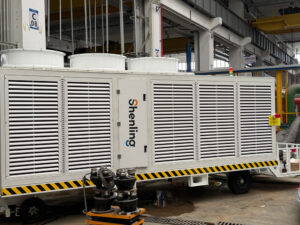
Introduction
Sensitive IT equipment in data centers, precision labs, telecom rooms and similar controlled environments requires not only precise temperature control but also stable humidity management. Our high-efficiency wet-membrane humidifier is purpose-built to maintain target relative humidity (RH) in 1% increments across a wide band, prevent electrostatic discharge, and ensure continuous, trouble-free operation. It combines robust mechanical design, advanced membrane technology, and industry-standard remote monitoring (RS485 / MODBUS) to deliver exactly the humidity control your mission-critical systems demand.
Why choose this humidifier?
-
Precision control (1% increments) — Microcomputer control and live display let you dial in RH accurately so environmental setpoints are held tightly.
-
Prevents static and protects equipment — Proper RH reduces the risk of electrostatic discharge (ESD), keeping servers, electronics and precision instruments safer.
-
Safe across water qualities — High-absorbency, flame-retardant, antibacterial membranes tolerate variable water conditions for reliable long-term use.
-
Low noise, even airflow — Branded centrifugal fan provides uniform air distribution with low operating sound — important for equipment rooms near offices.
-
Plug-and-play system integration — Self-diagnostics, oscillating airflow for even distribution and RS485/MODBUS remote monitoring simplify operation and maintenance.
Key Features & Benefits
Precise Humidity Control (30%–90%, 1% Steps)
Description: Microcomputer-based PID control enables fine RH adjustments in 1% increments across a 30%–90% RH range. Benefit: keep within narrow humidity windows preferred by data center and lab standards to reduce ESD risk and condensation concerns.
High-Absorbency, Flame-Retardant & Antibacterial Membrane
Description: Proprietary wet-membrane element offers very high water uptake, flame retardancy and antibacterial treatment. Benefit: safe, hygienic humidification even when supply water varies in quality — reduces fouling and microbial growth.
Branded Centrifugal Fan — Stable, Low Noise Airflow
Description: Premium centrifugal blower distributes humidified air evenly while maintaining low acoustic profile. Benefit: even humidity distribution without introducing disruptive noise into adjacent spaces.
Intelligent Control & Real-Time Display
Description: Onboard microcontroller shows current RH, setpoint, operating mode and diagnostics. Benefit: instant local feedback for technicians and easier commissioning.
Remote Monitoring & Integration (RS485 / MODBUS)
Description: Standard communications for integration into BMS/NMS systems. Benefit: remote setpoint changes, alarms and logging — ideal for centralized facility management.
Self-Diagnostic Fault Detection
Description: Continuous health checks identify membrane saturation, pump issues, fan abnormalities and water faults. Benefit: reduces downtime and simplifies maintenance planning.
Oscillating Airflow for Uniform Distribution
Description: Built-in oscillating airflow mechanism disperses moisture evenly across the room or duct. Benefit: avoids localized condensation and hot/cold spots in the controlled space.
Rugged, Service-Friendly Construction
Description: Modular access panels and standardized components reduce service time. Benefit: faster onsite servicing and lower lifecycle OPEX.
Core Applications
-
Data centers and server rooms (enterprise and colocation)
-
Telecom exchanges and switching centers
-
Precision equipment rooms, clean benches and electronics labs
-
Archive rooms, museums and climate-sensitive storage
-
Manufacturing lines for electronics where ESD control is required
Typical Technical Snapshot (example / configurable)
-
Operating RH range: 30%–90% RH, adjustable in 1% steps
-
Control: Microcomputer PID control with real-time display
-
Communication: RS485 / MODBUS standard
-
Air delivery: Branded centrifugal fan, low noise
-
Humidification media: Flame-retardant, antibacterial wet membrane
-
Diagnostics: Onboard self-test and fault alarms
-
Mounting: Floor or wall/duct candidates depending on model
Note: Exact model specifications (flow rate, power, dimensions) are configurable — request datasheet for model-specific values.
Installation & Maintenance — What to expect
-
Quick commissioning: Plug into BMS via RS485/MODBUS and set RH targets.
-
Routine maintenance: Inspect membrane quarterly (or per water quality), replace membrane per lifecycle (typical intervals depend on water hardness & duty cycle).
-
Consumables & spares: Membrane cartridges, pumps and filters are field-replaceable; recommended spare list provided at purchase.
-
Water conditioning: While membrane tolerates varied water qualities, installed pre-filtration (sediment/softener) extends membrane life in hard water conditions.
Compliance & Safety
Designed with flame-retardant membranes and safety diagnostics. Meets typical safety and electromagnetic compatibility expectations for industrial HVAC/equipment-room installations. For project bids, we’ll provide compliance documentation and recommended installation wiring diagrams.
FAQs
Q1: What humidity level should I set for a data center?
A: Industry practice commonly targets 45%–55% RH to minimize electrostatic discharge while avoiding condensation. Exact setpoints depend on equipment, ambient conditions and site policy.
Q2: How does a wet-membrane humidifier prevent static?
A: By keeping RH within the recommended window, the air becomes less prone to generating and sustaining static charge; the membrane provides controlled evaporation to maintain stable RH without oversaturation.
Q3: Is the membrane safe if my site water quality is poor?
A: Yes — the humidifier uses a high-absorbency, flame-retardant, antibacterial membrane designed to tolerate a range of water qualities. For very hard or contaminated water, we recommend pre-filtration to extend membrane life.
Q4: Can this unit be integrated with our Building Management System?
A: Absolutely — RS485 with MODBUS protocol is standard, enabling remote monitoring, alarms and data logging within most BMS/NMS platforms.
Q5: How often do I need to replace the membrane?
A: Replacement intervals depend on water quality and duty cycle. Typical membrane lifetimes range from several months to a few years; we provide recommended maintenance schedules and a membrane lifecycle estimate for each model.
Q6: Does the humidifier produce noise that will disturb nearby staff?
A: No — it uses a branded centrifugal fan for uniform airflow and low noise operation; dB levels are model-specific and provided in the datasheet.
Q7: What safety features are included?
A: Onboard self-diagnostics detect fan/pump faults, membrane saturation issues and water faults. The membrane is flame-retardant and antibacterial for safe, hygienic operation.
Q8: Can the system handle oscillating airflow for better distribution?
A: Yes — an oscillating airflow feature spreads humidified air more evenly, reducing localized hotspots and condensation risks.
Q9: Is remote firmware/software update supported?
A: Firmware update procedures vary by model. Remote configuration and parameter changes via MODBUS are supported; firmware update options can be discussed for specific project requirements.
Q10: How do I size the humidifier for my room or data hall?
A: Sizing depends on room volume, number of equipment racks, air exchange rate and target RH. Provide room dimensions, current HVAC airflow and setpoint and we’ll supply a recommended model and placement for optimal performance.
Q11: Are spare parts and consumables available?
A: Yes — membrane cartridges, pumps and fan assemblies are stocked as spares; we can provide a recommended spare parts list and lead times.